🌱✨ DNA Data Storage: When Biology Meets the Information Age ✨🧬
Have you ever stopped to think about where all our data—every photo, message, song, and document—will eventually live? Our current hard drives and cloud servers are amazing, but they’re starting to struggle under the sheer weight of our digital lives. 📈
What if I told you that one of the most promising solutions comes not from Silicon Valley, but from nature itself? Enter DNA data storage—a mind-blowing fusion of biology and computer science that could change everything. 🧪💾
🧠 So, Why Do We Need DNA to Store Data?
We’re generating data at an absolutely insane rate. Think about every search query, every social media post, every high-resolution video. Traditional storage methods (like magnetic tapes and hard drives) are hitting their limits:
- 📈 They’re running out of space: We’re approaching the physical limit of how much data we can squeeze onto a disk.
- 🔧 They’re high-maintenance: They degrade over time, need constant energy to maintain, and require expensive cooling systems.
- ⚡ They’re energy-hungry: Data centers already consume a massive amount of the world's electricity.
Meanwhile, DNA—the molecule that nature uses to store the blueprint of life—has been doing this efficiently for billions of years. It’s the ultimate storage device:
- 🧪 Unbelievable Density: A single gram of DNA could theoretically hold over 200 petabytes of data. That’s like storing the entire content of the internet in a shoebox!
- 🌡️ Incredibly Durable: Under the right conditions, DNA can last for thousands of years. We’ve sequenced DNA from ancient mammoths!
- 🔒 Never Becomes Obsolete: The "language" of DNA (A, C, G, T) will never go out of style. We’ll always be able to read it.
- 💡 Energy Efficient: Once it’s written, it doesn’t need any power to store the information. Just keep it cool and dry.
It sounds like science fiction, but researchers are already doing it in labs around the world!
🧪 How Does It Actually Work?
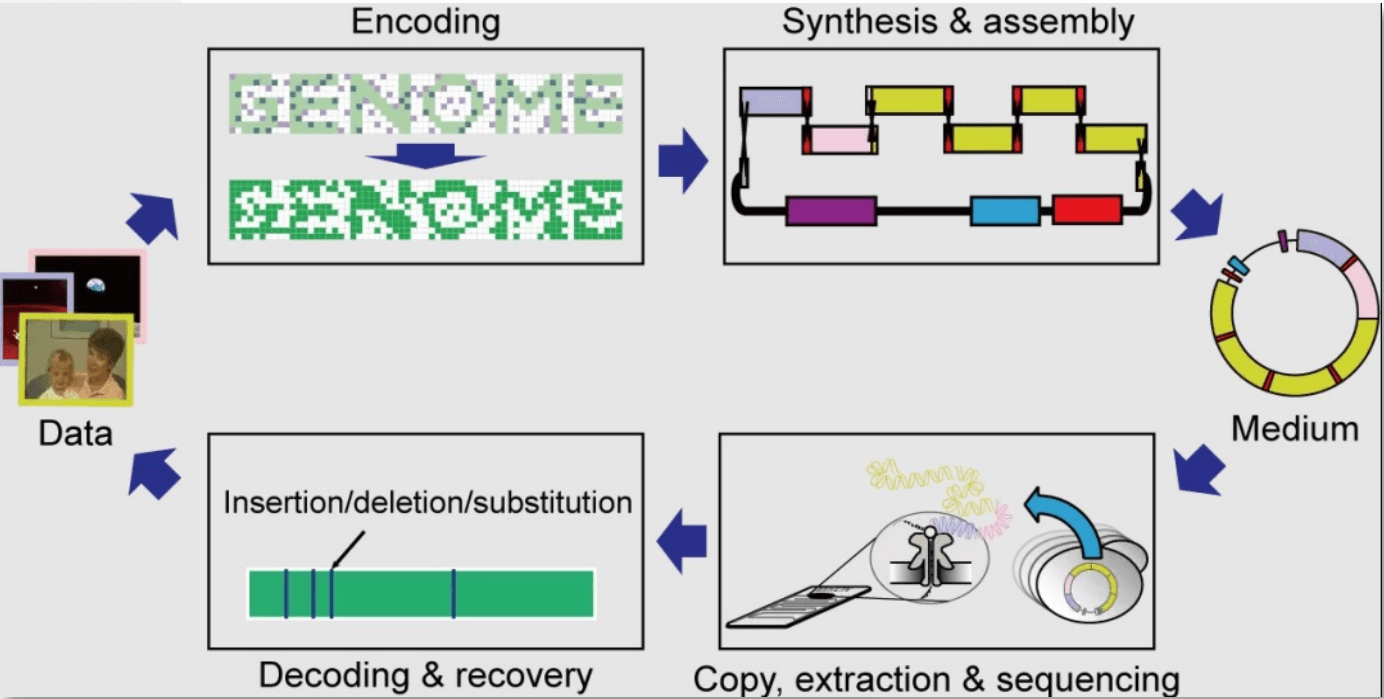
The process is like a super high-tech translation service between the digital and biological worlds.
- ENCODING 🔢→🧬: Software translates the 0s and 1s of a digital file into a sequence of the four DNA "letters": A, C, G, and T.
- SYNTHESIS (Writing) ✍️: A machine uses chemical or enzymatic processes to build that specific sequence of DNA from scratch.
- STORAGE 🧊: The synthetic DNA is carefully stored, often encapsulated in a tiny glass bead or tube to protect it from moisture and damage.
- SEQUENCING (Reading) 🔍: When the data is needed, the DNA is "read" using a sequencer (like a tiny nanopore reader) that identifies the order of the letters.
- DECODING 🧬→🔢: Software reverses the process, translating the A/C/G/T sequence back into the original 0s and 1s, reconstructing your file perfectly!
It’s essentially using biology’s own information system to store our digital world. How cool is that?
📊 DNA Storage vs. Traditional Storage (At a Glance)
| Feature | DNA Storage | Traditional Hard Drive |
|---|---|---|
| Density | Extremely High (Exabytes/gram) | Low (Terabytes/disk) |
| Longevity | Thousands of years (stable) | 5-10 years (degrades) |
| Energy Use | Nearly zero (after writing) | Constant power needed |
| Maintenance | Low (just store it) | High (cooling, monitoring) |
| Read/Write Speed | Slow (for now!) | Very Fast |
| Cost (to write) | Very High (but falling fast!) | Very Low |
🌱 This is a Triumph of Biotechnology
This isn't just an IT project; it's a flagship application of synthetic biology. We're not just reading DNA anymore; we're writing it to serve our own purposes.
In just the last few years, researchers have:
- Stored entire books, operating systems, and movies in DNA.
- Used CRISPR gene-editing systems to store data inside the DNA of living bacteria (a living hard drive!).
- Developed clever error-correcting codes to fix mistakes that occur during synthesis and sequencing.
- Pioneered new enzymatic synthesis methods that are faster and greener than traditional chemistry.
🔮 What Does the Future Look Like?
We're still in the early days, and there are hurdles like cost and speed to overcome. But the potential is staggering:
- 🧊 The Ultimate Archive: Preserving humanity's cultural heritage—libraries, historical records, knowledge—for millennia.
- 🧪 Living Diagnostic Tools: Cells in your body could record health data over time.
- 🔐 Biological Encryption: Ultra-secure data hiding using DNA sequences.
- 🌍 Deep Space Storage: Its durability and density make it perfect for long-duration space missions.
💬 Let's Wrap It Up
DNA data storage is no longer a far-fetched idea—it's a rapidly advancing field at the intersection of biology and technology. While you won't be saving your selfies to a DNA drive next year, the path forward is incredibly exciting.
The next time you look at a DNA helix, remember: it’s not just the code of life. It might just be the future of memory. 🧬📦