The Geometry of Time: Martin Armstrong and the Power of 8.6
Beyond the hexagrams of the I Ching and the frequencies of Nikola Tesla lies a mathematical framework that claims to predict the future. Martin Armstrong, a former billionaire investment advisor, suggests that the universe operates on a simple, recurring frequency. This is not mere speculation; it is a theory that led to an FBI raid and the longest imprisonment for civil contempt in American history.
The Sacred Constant: Connecting Pi to the Market
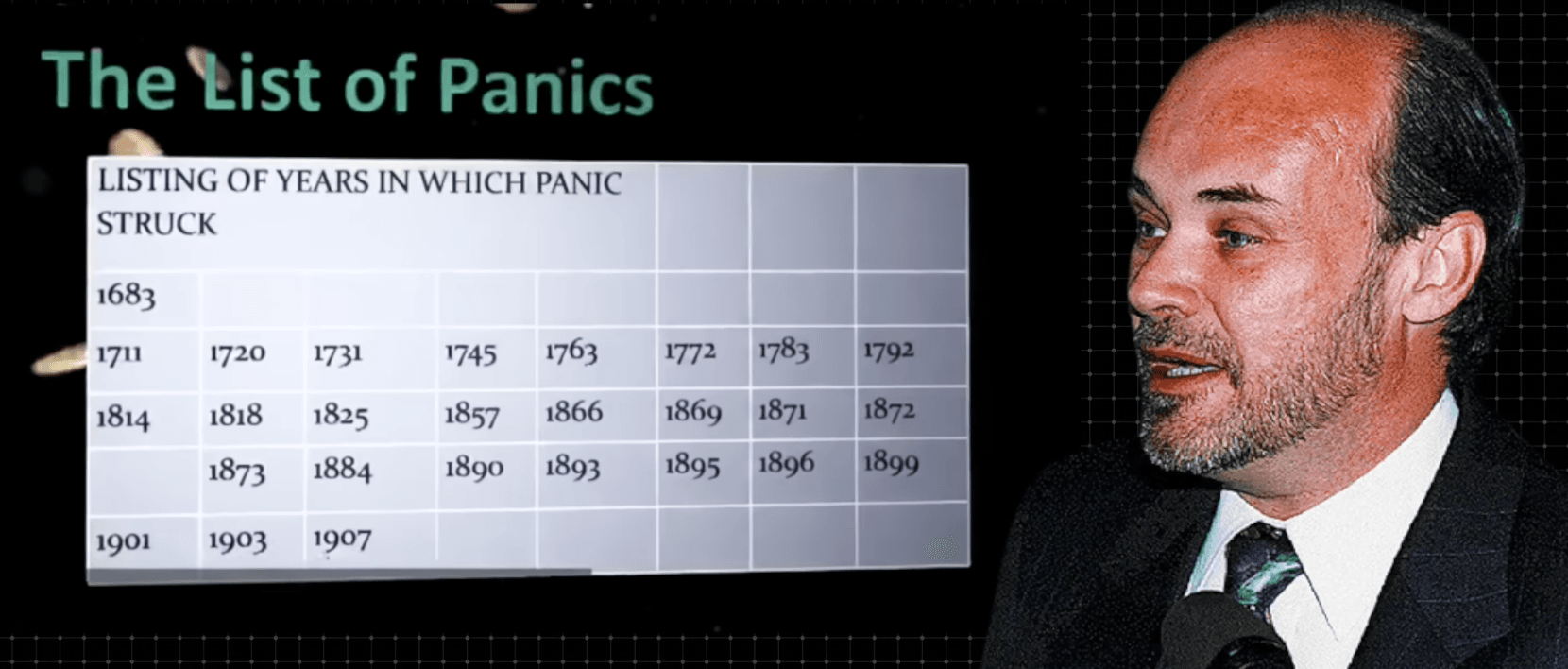
Armstrong’s obsession with cycles began after a massive teenage investment loss. While studying millennia of monetary history, he realized that financial panics were not random. They occurred with a rhythmic precision that pointed toward a universal constant: ****.
By calculating the average time between 26 major financial panics from 1683 to 1907, he arrived at the number 8.6. He soon discovered the hidden link:
This is essentially . Armstrong argued that just as defines the physical structure of a circle, it also defines the wave-like patterns of human collective behavior and economic confidence.
The Seasons of History: Kondratiev vs. Armstrong
Armstrong’s work is often compared to the "K-Waves" (Kondratiev Waves) proposed by Soviet economist Nikolai Kondratiev. Both believe history is cyclical, but they differ in scale and precision.
| Theory | Core Driver | Duration | Precision |
|---|---|---|---|
| Kondratiev Waves | Technological Revolutions (Steam, Internet) | 50 to 60 Years | Macro Trends (Seasons) |
| Armstrong Model | Capital Confidence & Math () | 8.6 Years (and multiples) | Specific Turning Points |
While the K-Wave tells you that "winter" is coming, Armstrong’s "Socrates" supercomputer claims to predict exactly which day the heaviest snow will fall. This precision allowed him to predict the 1987 "Black Monday" crash and the 1989 collapse of the Japanese Nikkei index, earning him the title of "Economic Tsar."
The Prisoner of Logic: The Socrates System
In 1999, the US government accused Armstrong of running a Ponzi scheme. However, Armstrong maintained that the authorities were actually after the source code of his Socrates system. He claimed the government viewed it as a "weapon of mass destruction" because it could predict political unrest and the collapse of empires.
Because he refused to hand over the source code and assets, a judge held him in civil contempt. Without a criminal trial, he was kept in prison for seven years. Even while behind bars, his model continued to issue warnings, including the 2008 financial crisis and the 2011 Japanese economic downturn caused by the Fukushima disaster.
Future Warnings: The Road to 2032
Now a free man and a staunch critic of centralized government, Armstrong uses his model to warn of a turbulent road ahead. His current projections suggest a world in transition.
First, the immediate downturn. His model indicates that the downward cycle triggered by the 2020-2021 global events will not bottom out until 2028. This suggests that the current year, 2026, is a critical period of heightened tension as the "lubricant" of the global economy begins to dry up.
Second, the specter of conflict. Armstrong predicts that World War III could manifest as a "hybrid war" involving military, trade, and economic sectors, peaking around 2032. This timeline aligns with the actions of various billionaires who have been constructing massive survival bunkers in remote locations like New Zealand and Hawaii.
Third, the shift of the "Empire Cycle." He believes empires operate on a 314-year cycle (). As the Western capital cycle nears its winter, he predicts global financial gravity will shift back toward the East, specifically naming Hong Kong as a potential future center for this mathematical resonance.
Conclusion: Watching the Waves
Whether Martin Armstrong is a true visionary or a master of coincidence, his story challenges the idea that history is a series of random events. If the universe truly follows a frequency, we are all just riders on a wave that was set in motion long ago.